

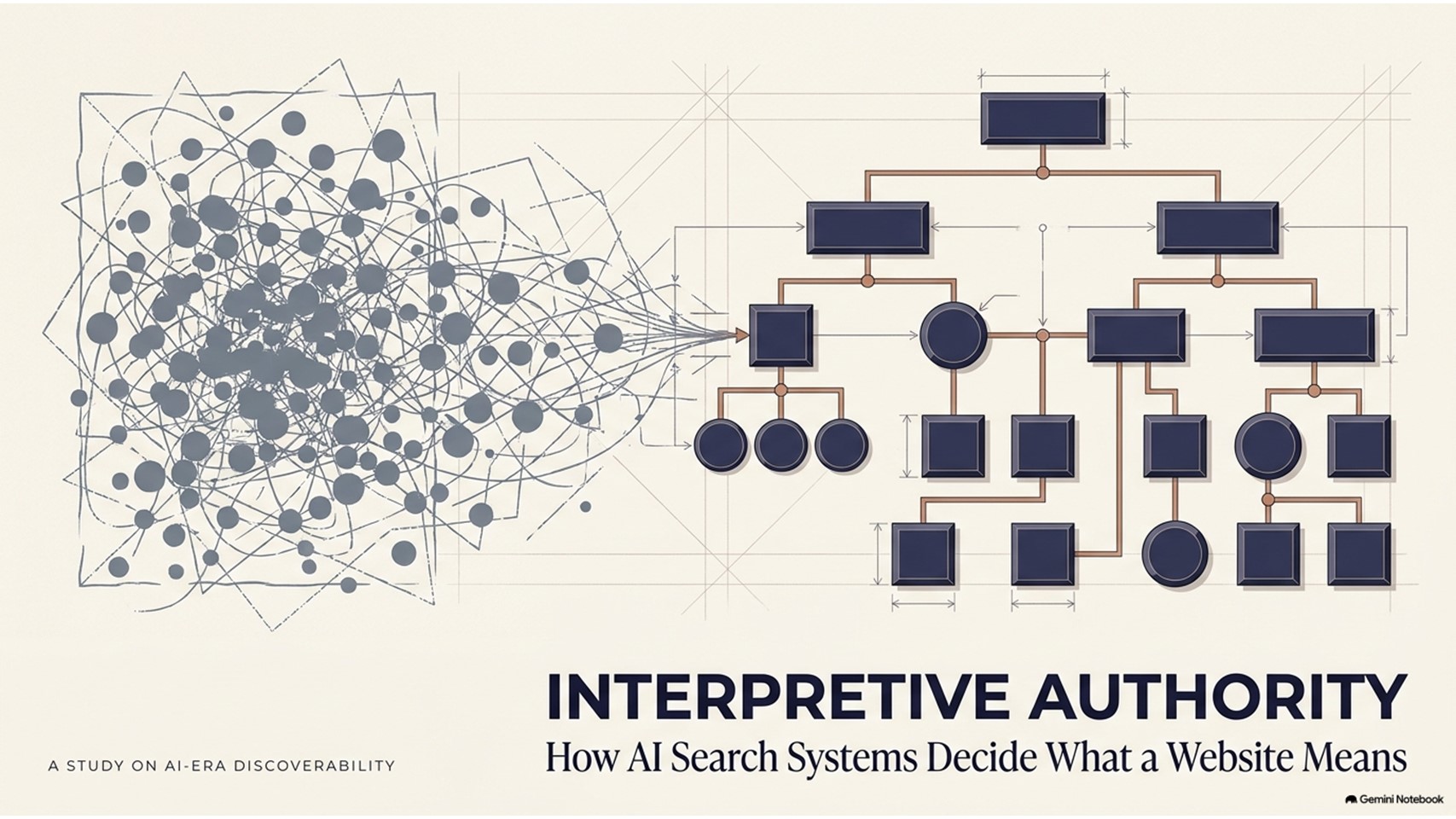
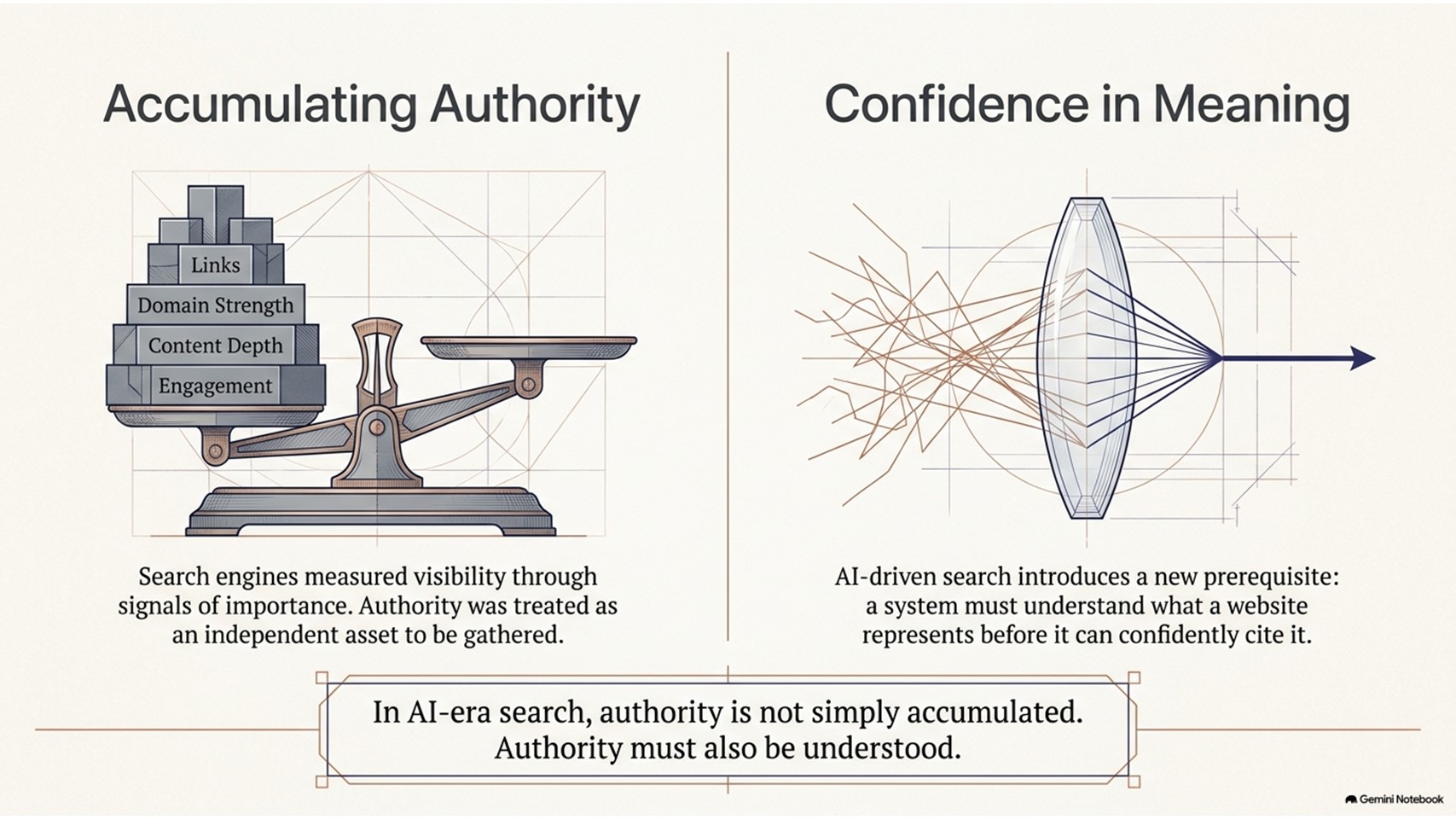
Search authority has traditionally been measured through signals of importance. Links, domain strength, content depth, relevance, engagement, and other indicators helped search engines determine which pages deserved greater visibility. These signals remain important, but AI-driven search introduces another requirement that is becoming increasingly significant: a system must first understand what a website represents before it can confidently use that website as a source.
This introduces the concept of Interpretive Authority.
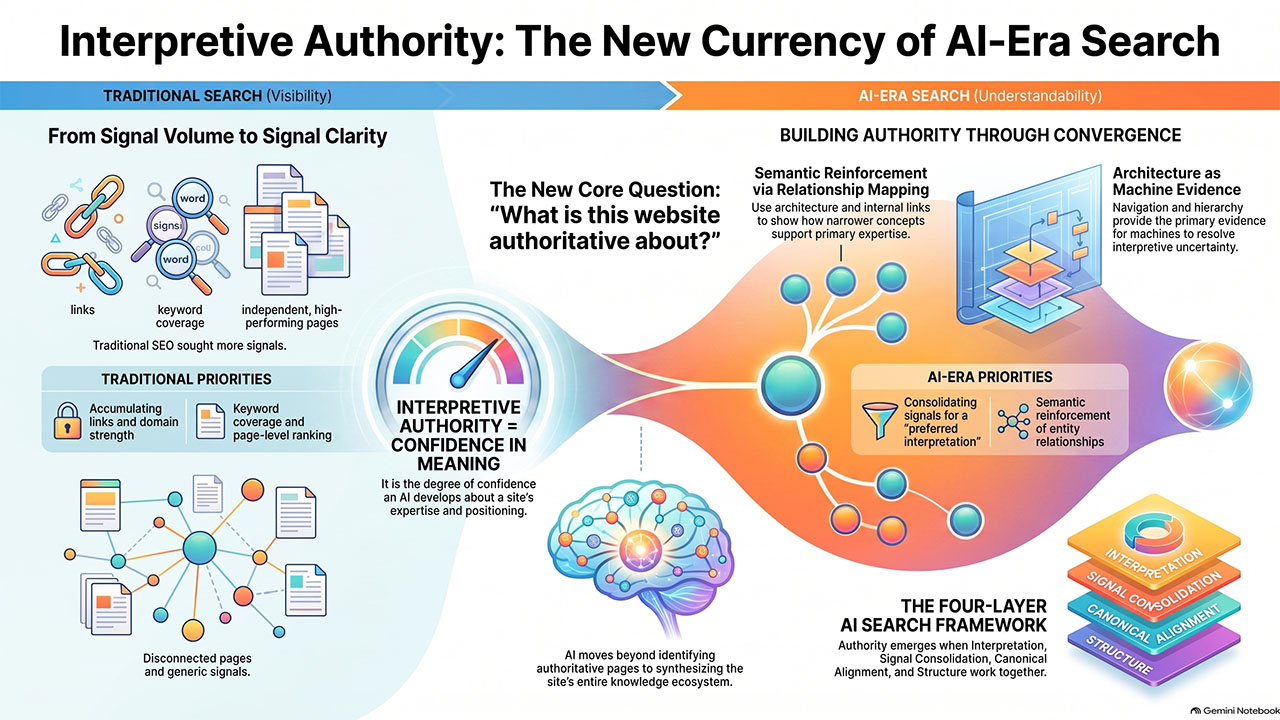
Interpretive Authority describes the degree of confidence a search or AI system can develop about the meaning, expertise, relationships, and positioning represented by a digital ecosystem.
A website may possess considerable conventional authority while still sending ambiguous signals about what it actually means. Conversely, a carefully structured website can reinforce its identity so consistently that its subject relationships become increasingly easy for machine systems to interpret.
In AI-era search, authority is not simply accumulated.
Authority must also be understood.
What Is Interpretive Authority?
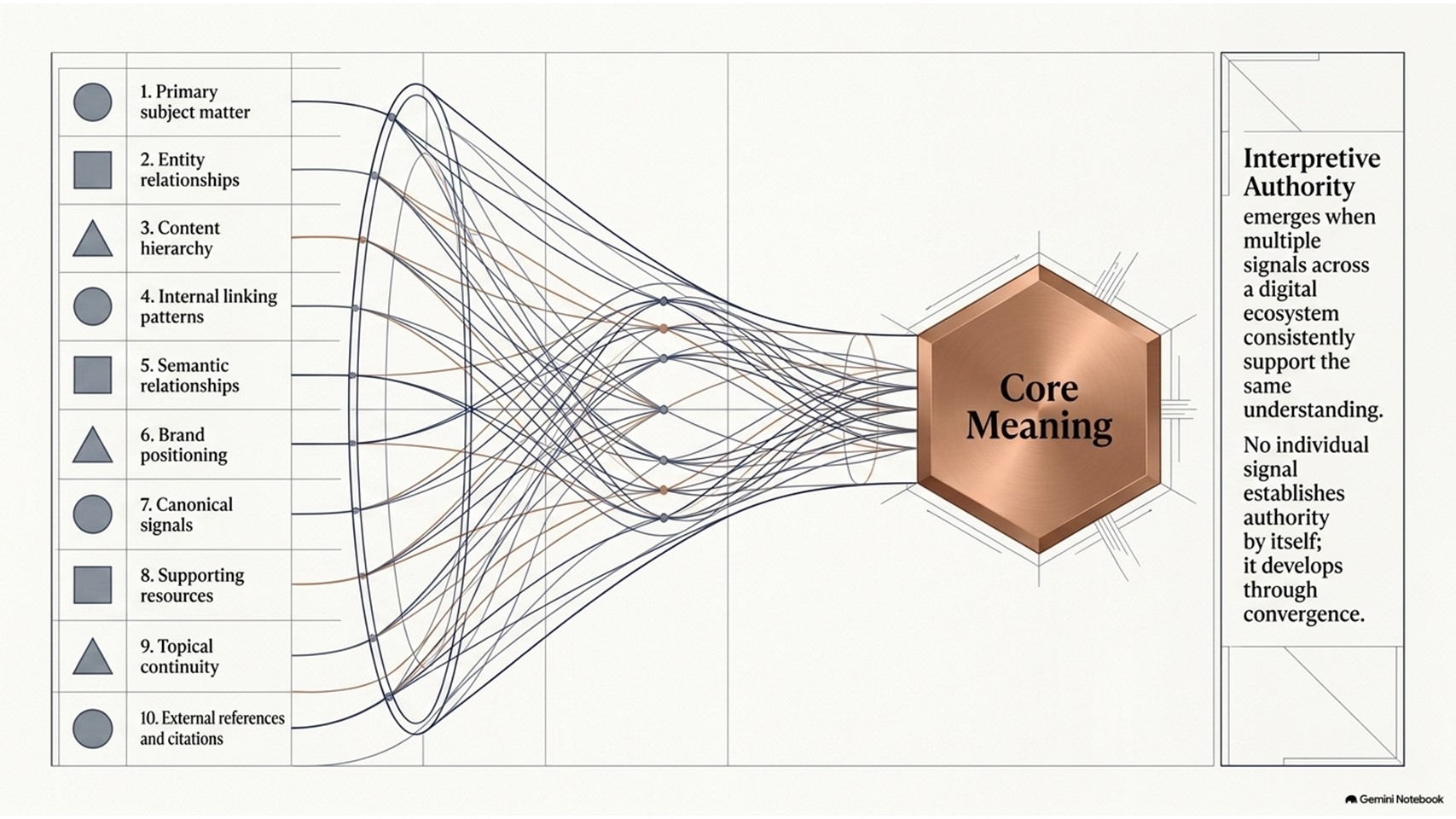
Interpretive Authority emerges when multiple signals across a digital ecosystem consistently support the same understanding.
Those signals may include:
- Primary subject matter
- Entity relationships
- Content hierarchy
- Internal linking patterns
- Semantic relationships
- Brand positioning
- Canonical signals
- Supporting resources
- Topical continuity
- External references and citations
No individual signal establishes Interpretive Authority by itself.
Instead, authority develops through convergence.
When pages, resources, entities, links, and structural relationships repeatedly reinforce compatible meanings, an AI system has less ambiguity to resolve. The system can develop greater confidence about what the website represents and how individual pieces of information relate to the larger knowledge structure.
Interpretive Authority therefore represents more than topical relevance.
It represents confidence in meaning.
Why Authority Without Meaning Is Incomplete
Traditional search optimization frequently approached authority as something that could be strengthened independently: acquire more links, publish more content, improve individual pages, and expand keyword coverage.
Those activities can create valuable signals, but greater signal volume does not automatically create greater clarity.
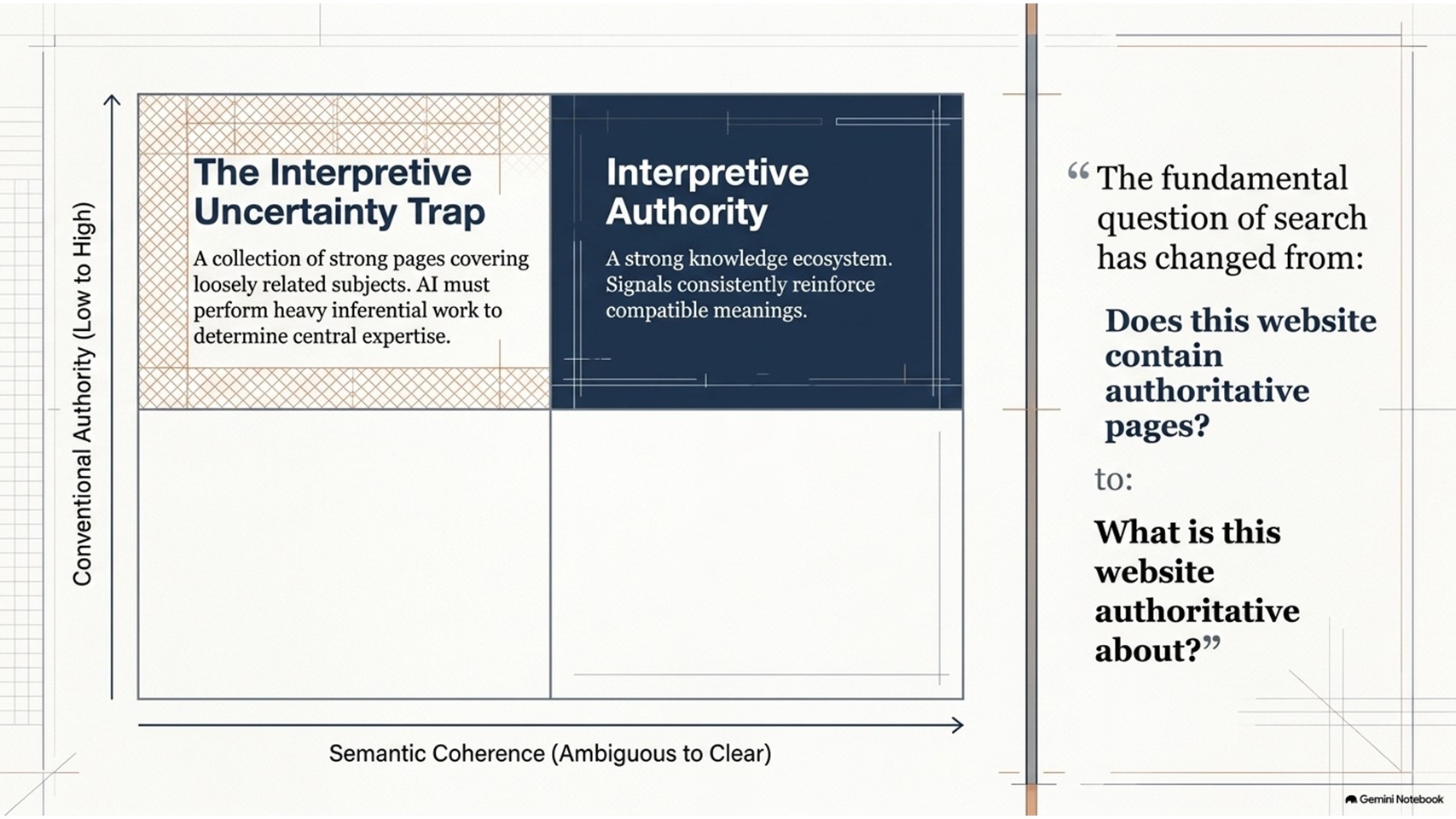
Consider a website containing hundreds of pages covering loosely related subjects. Individual pages might rank well, attract links, and demonstrate expertise. Yet if the relationships among those pages are unclear, an AI system must perform additional interpretive work to determine the website’s central areas of authority.
This creates interpretive uncertainty.
AI-driven search systems increasingly operate by synthesizing relationships among information rather than simply matching documents with queries. In that environment, a collection of strong pages is not necessarily equivalent to a strong knowledge ecosystem.
The question changes from:
“Does this website contain authoritative pages?”
to:
“What is this website authoritative about?”
That distinction is central to Interpretive Authority.
How AI Systems Build an Interpretation of a Website
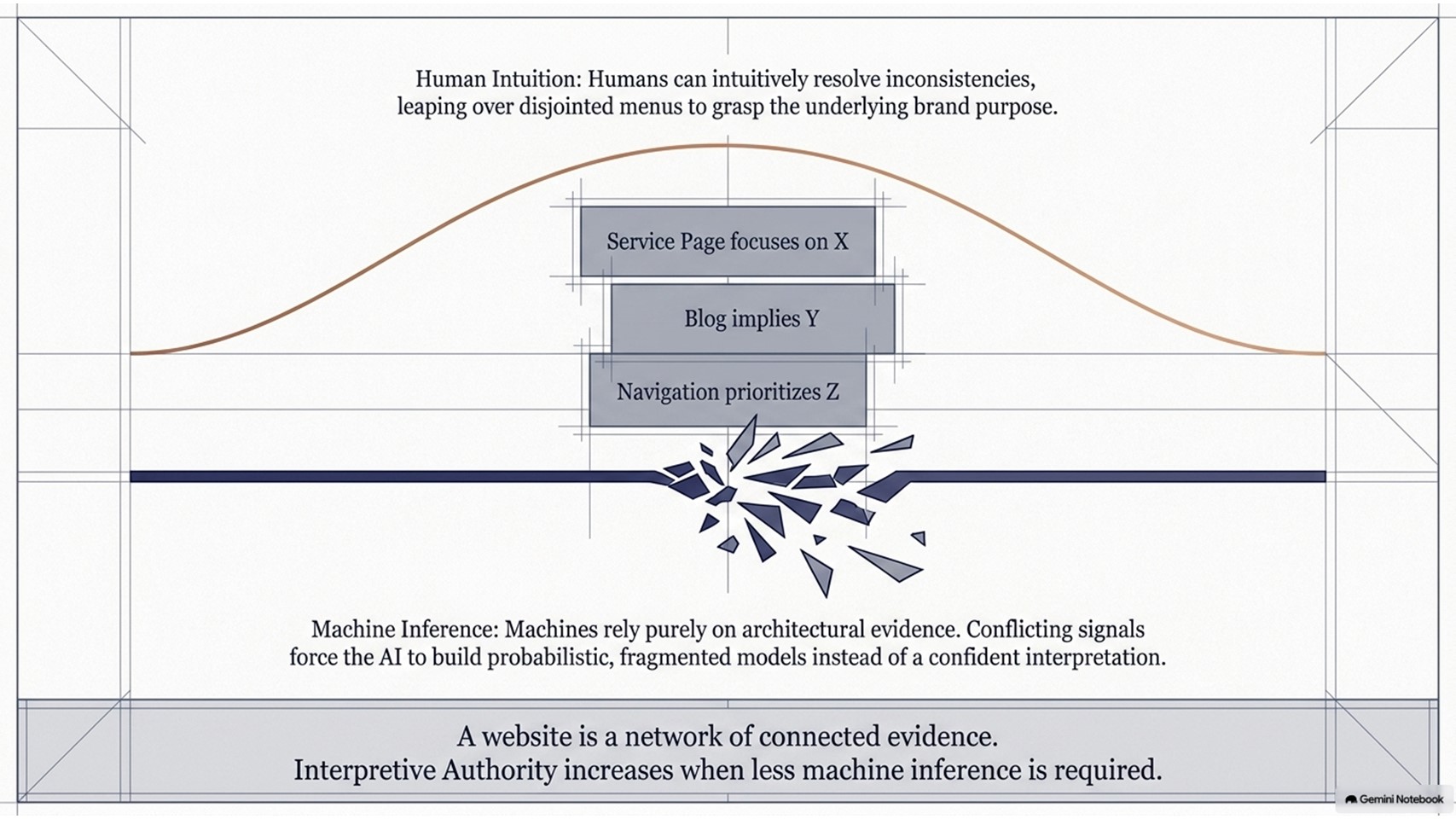
A website can be viewed as a network of connected evidence.
Every page contributes information about the larger system. Navigation communicates hierarchy. Internal links establish relationships. Repeated terminology reinforces concepts. Supporting articles provide contextual depth. Canonical signals indicate preferred representations. External references can further validate associations.
AI systems can synthesize these signals into an interpretive model.
When those signals reinforce one another, the model becomes clearer.
When they conflict, interpretation becomes more probabilistic.
For example, a website may repeatedly describe itself one way on primary service pages while publishing supporting content that implies a substantially different focus. Navigation may establish one hierarchy while internal links establish another. Multiple pages may compete to represent the same central concept.
Humans can often resolve these inconsistencies intuitively.
Machines must infer the intended relationship from available evidence.
Interpretive Authority increases when less inference is required.
Semantic Reinforcement Creates Confidence
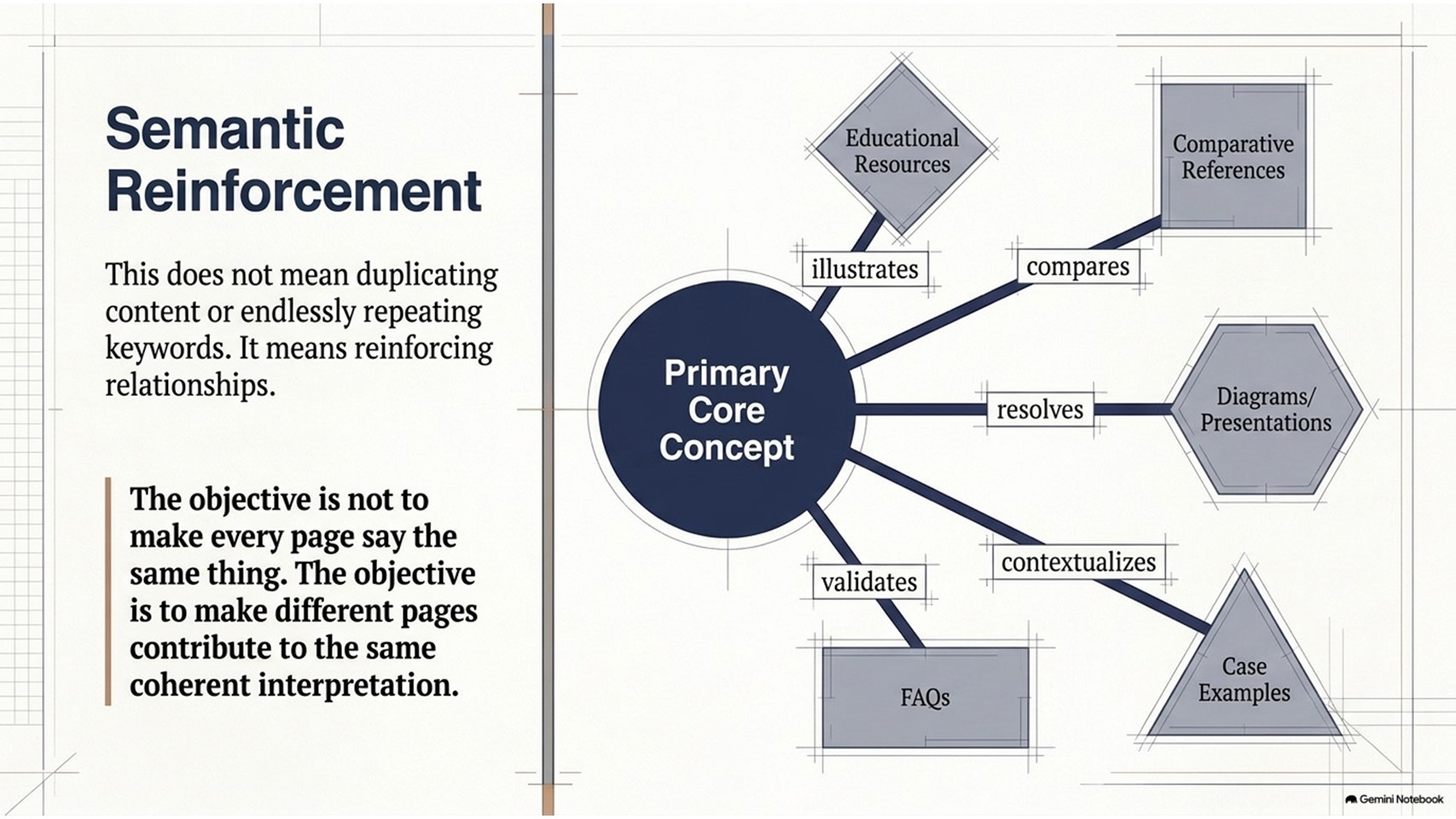
Repetition in this context does not mean duplicating content or repeatedly inserting the same keywords.
It means reinforcing relationships.
A primary concept can be supported by narrower concepts. Those concepts can be explained through educational resources, comparative references, diagrams, presentations, case examples, FAQs, and related articles.
Each asset contributes another piece of evidence to the larger semantic structure.
The objective is not to make every page say the same thing.
The objective is to make different pages contribute to the same coherent interpretation.
This creates semantic reinforcement.
Over time, a well-designed content ecosystem can establish increasingly clear associations among the organization, its expertise, its original concepts, and the subjects for which it seeks recognition.
Canonical Meaning and Interpretive Authority
Canonicalization is commonly understood as a technical mechanism for identifying preferred URLs. In AI-era search architecture, however, the broader concept of canonical meaning becomes equally important.
A digital ecosystem should communicate a preferred interpretation of its identity.
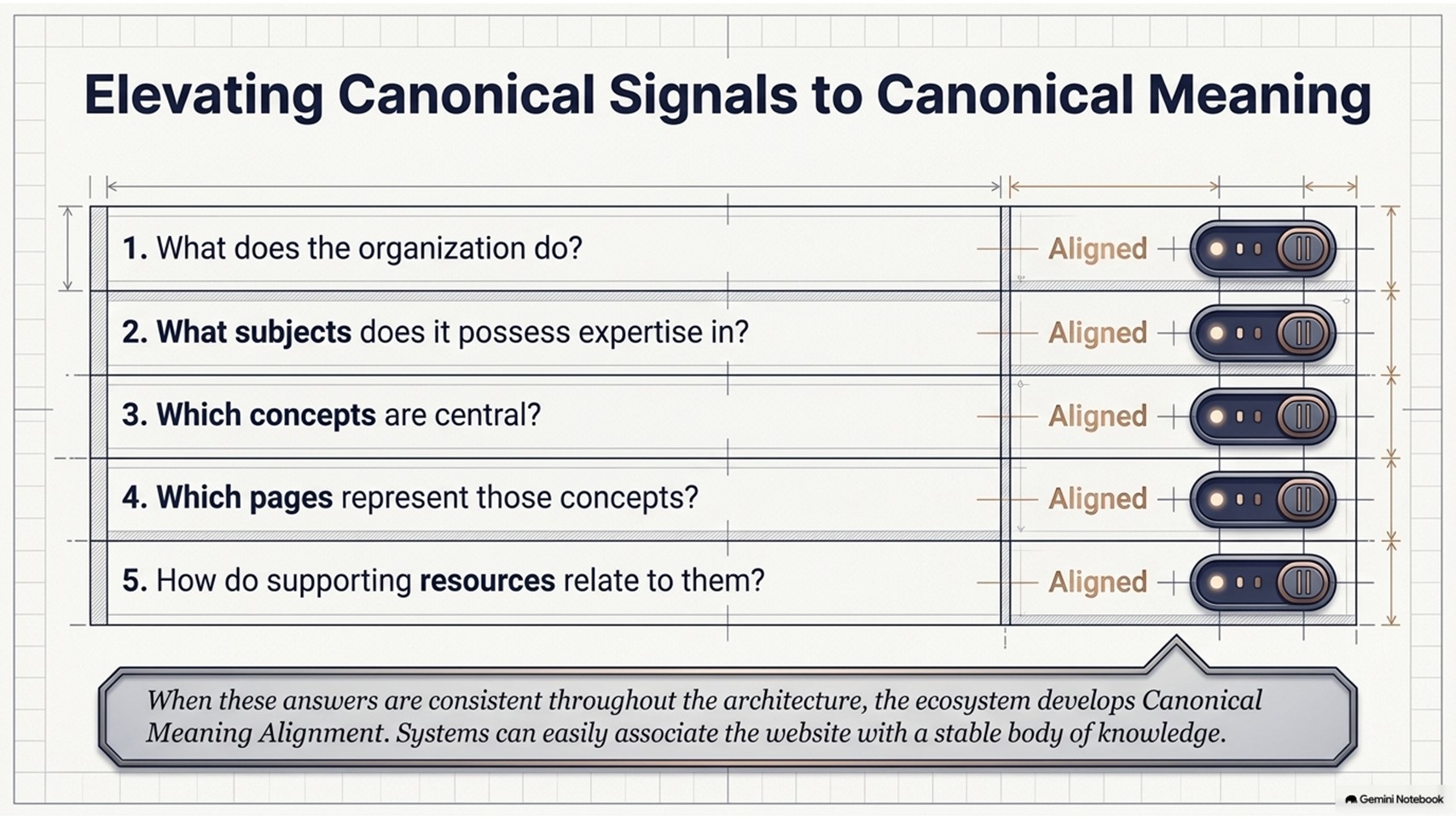
What does the organization do?
What subjects does it possess expertise in?
Which concepts are central?
Which pages represent those concepts?
How do supporting resources relate to them?
When these answers are consistent throughout the architecture, the ecosystem develops canonical meaning alignment.
Interpretive Authority can be viewed as one outcome of that alignment.
The clearer the canonical meaning, the easier it becomes for systems to associate the website with a stable body of knowledge.
Website Architecture Becomes Evidence
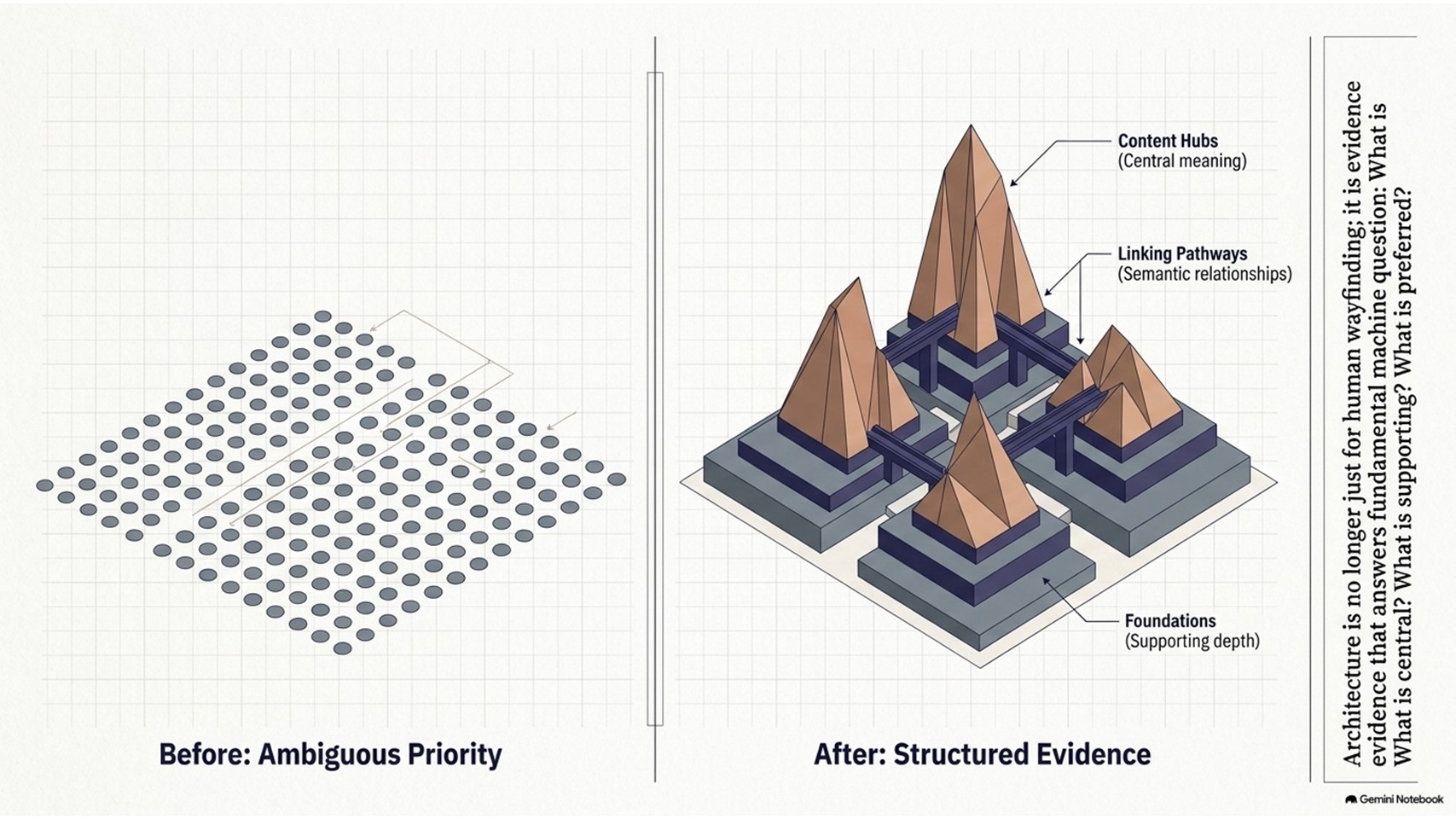
Website architecture is no longer simply a mechanism for helping visitors find pages.
Architecture itself communicates meaning.
A hierarchical relationship between pages indicates that one concept belongs beneath another. Internal links suggest semantic relationships. Content hubs establish areas of concentration. Supporting resources demonstrate depth. Navigation communicates priority.
Even publishing continuity can become part of the interpretive structure.
This means architecture provides evidence that helps machines answer fundamental questions:
What is central?
What is supporting?
What is related?
What is authoritative?
What should be treated as the preferred source?
A coherent architecture repeatedly answers those questions in compatible ways.
Interpretive Authority and the Four-Layer AI-Era Search Framework
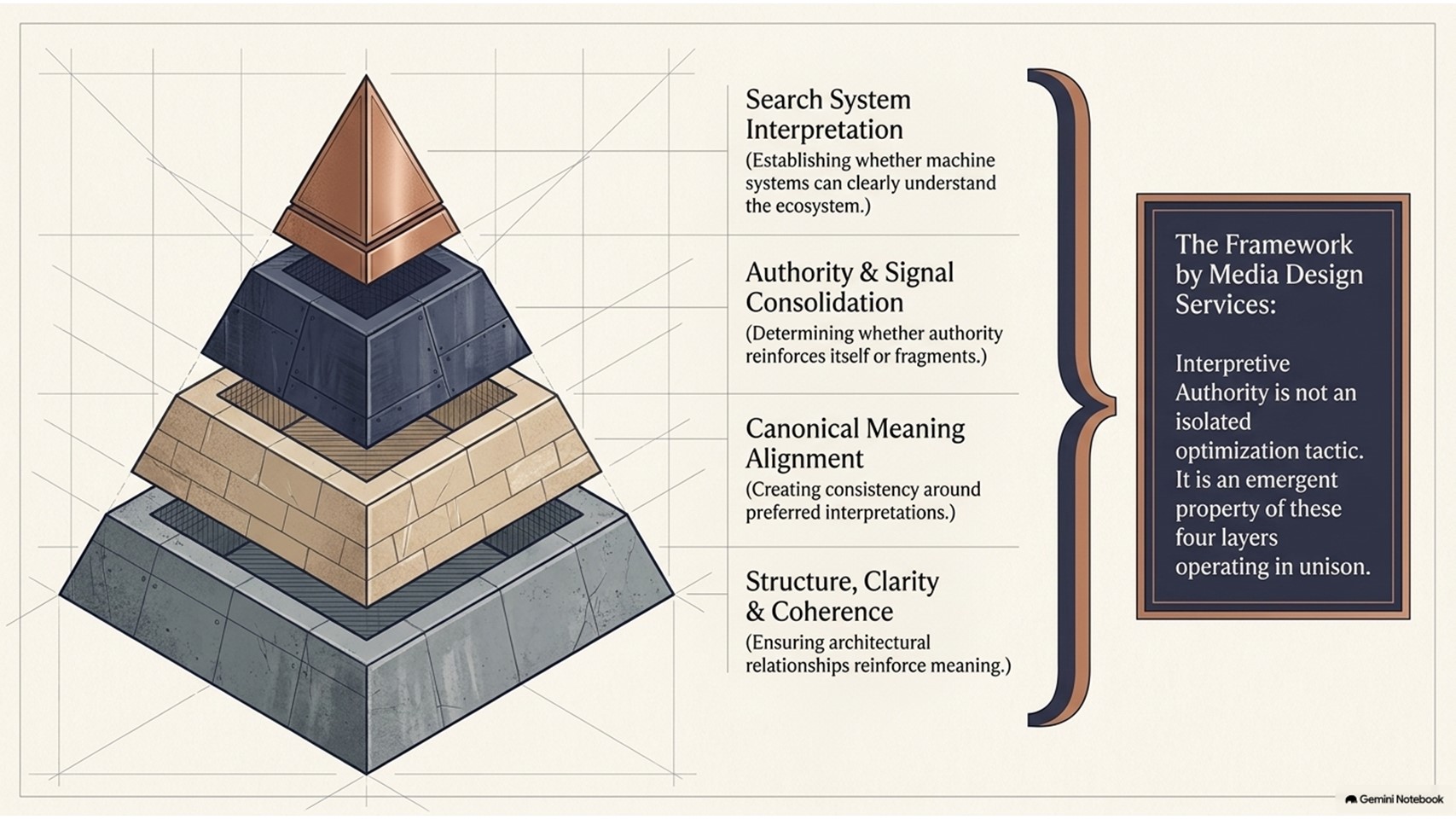
Interpretive Authority builds naturally upon the Four-Layer AI-Era Search Framework developed by Media Design Services.
The framework identifies four interconnected layers of AI-era discoverability:
Search System Interpretation establishes whether machine systems can clearly understand the ecosystem.
Authority & Signal Consolidation determines whether authority reinforces itself or becomes fragmented.
Canonical Meaning Alignment creates consistency around preferred interpretations.
Structure, Clarity & Coherence ensures that architectural relationships reinforce meaning throughout the system.
When these four layers operate together, they create conditions in which Interpretive Authority can develop.
Interpretive Authority is therefore not another isolated optimization tactic.
It is an emergent property of a coherent digital ecosystem.
From Ranking Authority to Interpretive Authority
Traditional SEO asked how a website could become more visible.
AI-era search introduces a deeper question:
How can a digital ecosystem become more understandable?
The two objectives are increasingly interconnected.
A system cannot confidently surface, cite, summarize, or associate information that it cannot reliably interpret. As search environments become more dependent upon AI-generated synthesis, knowledge relationships and contextual understanding become increasingly important components of discoverability.
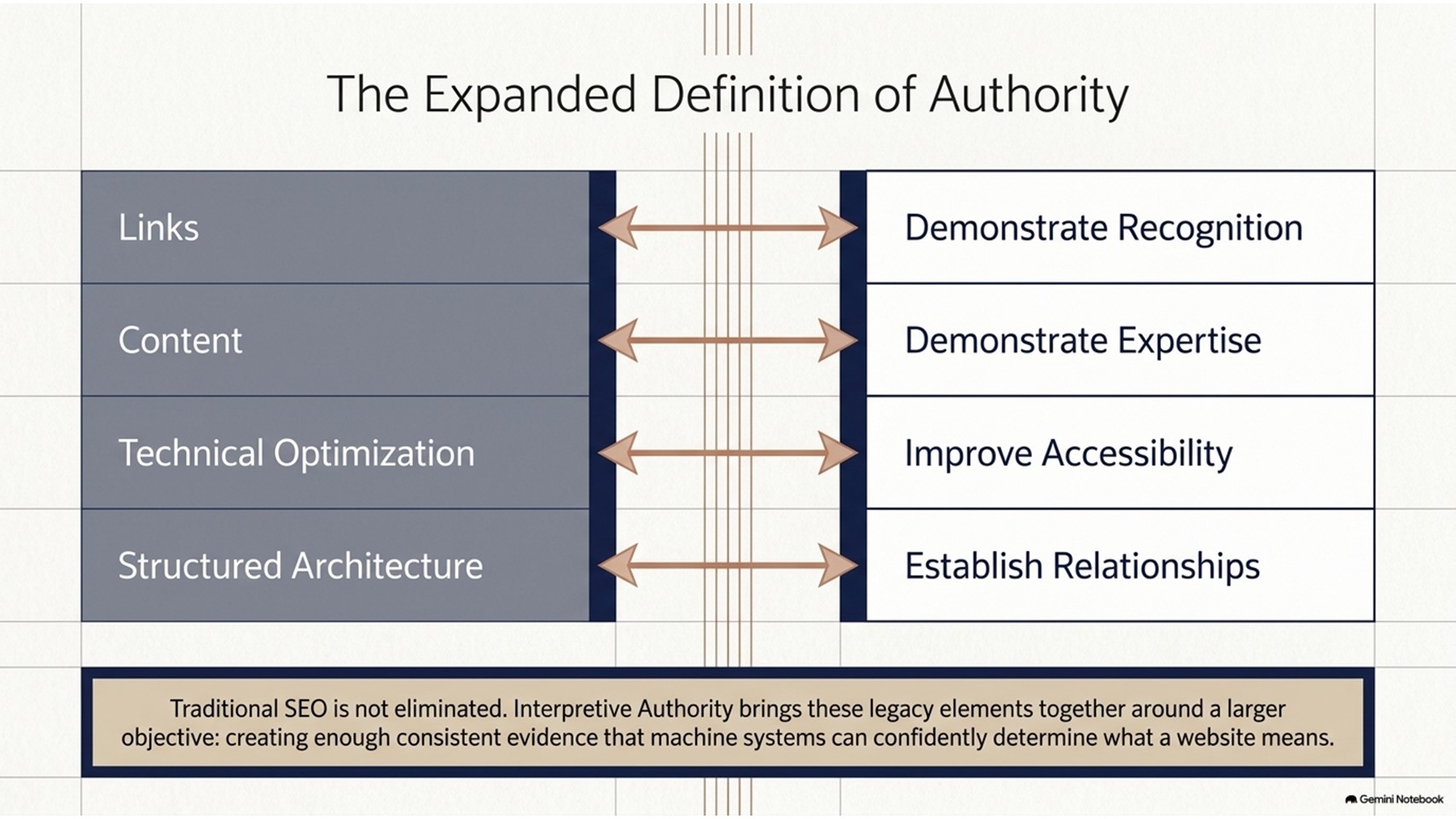
This does not eliminate traditional SEO.
It expands the definition of authority.
Links can demonstrate recognition. Content can demonstrate expertise. Technical optimization can improve accessibility. Structured architecture can establish relationships.
But Interpretive Authority brings these elements together around a larger objective:
creating enough consistent evidence that machine systems can confidently determine what a website means.
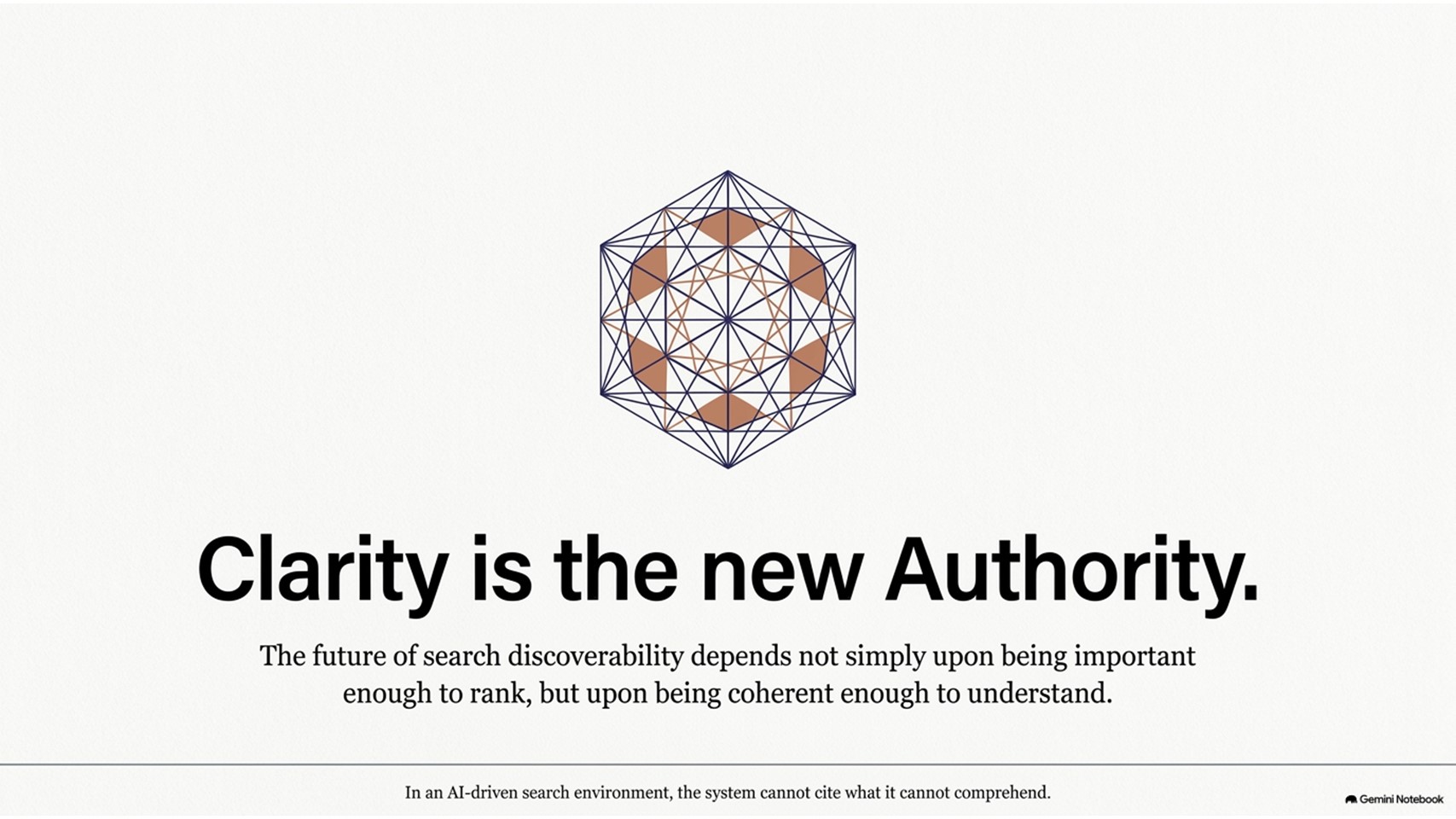
The future of search authority may therefore depend not simply upon being important enough to rank, but upon being coherent enough to understand.
In an AI-driven search environment, clarity itself becomes a form of authority.
Frequently Asked Questions About Interpretive Authority
What is Interpretive Authority in AI search?
Interpretive Authority is the degree of confidence an AI or search system can develop about what a website represents, what subjects it demonstrates expertise in, and how its pages, entities, and supporting resources relate to one another. It develops when multiple signals consistently reinforce the same meaning across a digital ecosystem.
How is Interpretive Authority different from traditional SEO authority?
Traditional SEO authority has generally emphasized signals such as backlinks, relevance, content quality, and domain strength. Interpretive Authority adds another dimension: whether machine systems can confidently understand what that authority represents. A website may possess strong traditional signals while still creating uncertainty about its primary expertise, relationships, or meaning.
How can a website build Interpretive Authority?
A website can strengthen Interpretive Authority by creating clear content hierarchies, consistent terminology, purposeful internal links, well-defined entity relationships, supporting resources, and strong canonical meaning alignment. The objective is not to repeat identical information but to create multiple forms of evidence that reinforce a coherent interpretation of the website and its expertise.